NASA Buys a Falcon 9 Rideshare Seat for StarBurst, and the Launch Slides to 2028
NASA says its StarBurst gamma-ray satellite will fly on a Falcon 9 rideshare no earlier than 2028, while the agency's own mission pages still list a launch in summer 2027 timed to a gravitational-wave observing run.
NASA announced on 17 September 2026 that it had selected SpaceX to launch StarBurst, a small satellite built to catch the first flash of high-energy light from merging neutron stars. The award is a firm-fixed-price task order placed under NASA's VADR launch services contract, according to contract release C26-012. StarBurst will ride as a payload on a Falcon 9 Bandwagon rideshare mission out of Space Launch Complex 40 at Cape Canaveral Space Force Station in Florida. The release gives the window as no earlier than 2028.
That date is the part worth reading twice. NASA's Astrophysics Pioneers page gives StarBurst "a target launch date of summer 2027 (aligned with LIGO's O5 observing run)", and the StarBurst mission page lists Launch 2027. Both pages were carrying those dates on 22 September 2026, five days after the award. A NASA Marshall article dated 9 January 2026 said the team intended the satellite to be launch-ready by June 2026 and that NASA planned to launch as early as 2027, timed to LIGO's next observing run. The contract release does not mention the earlier dates, explain the change, or say what it means for the observing plan.
Why a year matters on this particular satellite
The slip runs straight at the reason the mission exists. A gamma-ray burst becomes a multimessenger event only if a gravitational-wave detector is running at the same moment. NASA's release frames the science as combining StarBurst's observations with gravitational-wave measurements and follow-up from other telescopes.
The base rate is one. Only a single neutron star merger has ever been seen in gravitational waves and gamma rays at the same time, GW170817, on 17 August 2017. NASA says StarBurst is expected to find up to 10 such events a year. That projection rests on the detectors keeping pace: by 2027, NASA says, LIGO is expected to finish sensitivity upgrades under the NSF-approved A+ configuration, which should yield neutron star merger detections at a rate of more than one per week. Whether LIGO's O5 run still overlaps a 2028 launch is not addressed in any NASA document read for this story.
What the contract says, and what it does not
NASA does not publish what it is paying. The release names no value for the task order. The agency's Astrophysics Pioneers Program, which StarBurst belongs to, carries a $20 million cost cap, but NASA does not say whether the launch sits inside that cap or is carried separately by the Launch Services Program.
NASA's two statements of the VADR ceiling also do not agree. The 17 September 2026 release describes an indefinite-delivery, indefinite-quantity contract allowing NASA to acquire launch services over a 10-year ordering period with a maximum total value of $1 billion across all contracts. NASA's standing VADR reference page, accessed on 22 September 2026, states a five-year ordering period and a maximum total value of $300 million across all contracts, on a page whose company list is current "as of July 2025". NASA does not explain the difference, give a date for an extension, or say whether the contract was re-competed, extended or on-ramped again.
"This indefinite-delivery/indefinite-quantity contract allows NASA to acquire launch services during a 10-year ordering period, with a maximum total value of $1 billion across all contracts."
The VADR page says the contract deliberately applies less agency oversight and more commercial flexibility than NASA's other launch contracts, and covers payloads from CubeSats up to Class D missions, which NASA calls the least expensive and most risk tolerant of its four mission classes. Task orders are issued as needed, and providers were picked in two rounds, 13 companies in 2022 and three more in 2024 under an on-ramp provision. NASA lists the awardee as SpaceX, legally Space Exploration Technologies Corp. of Hawthorne, California. The Launch Services Program Office at Kennedy Space Center manages the contract.
The hardware and the people who built it
The mission is led by principal investigator Daniel Kocevski at NASA's Marshall Space Flight Center in Huntsville, Alabama, which also holds overall project management. NASA sets out the partner roles: the Naval Research Laboratory designed and fabricated the instrument, the University of Alabama Huntsville wrote the instrument flight software, the Universities Space Research Association runs the science operations centre, and the UTIAS Space Flight Laboratory supplies the spacecraft bus and the mission operations centre.
The instrument is 12 CsI(Tl) scintillation detectors sensitive across the 30 to 1,000 keV range, oriented to watch the entire portion of sky not blocked by Earth. Silicon photomultipliers convert the light the crystals produce into a measurable voltage, an onboard clock synchronised to GPS timestamps each gamma ray, and the relative signal strengths across detectors give the source position. NASA puts the effective area at over five times that of the Fermi Gamma-ray Burst Monitor. The spacecraft reaches low Earth orbit as a secondary payload through the ESPA Grande interface, for a nominal one-year mission.
NASA lists four primary science objectives: constrain the progenitors of short gamma-ray bursts, probe the remnants of neutron star mergers, constrain the neutron star equation of state, and probe the structure of relativistic outflows produced in neutron star mergers.
A build that has already been through the shaker
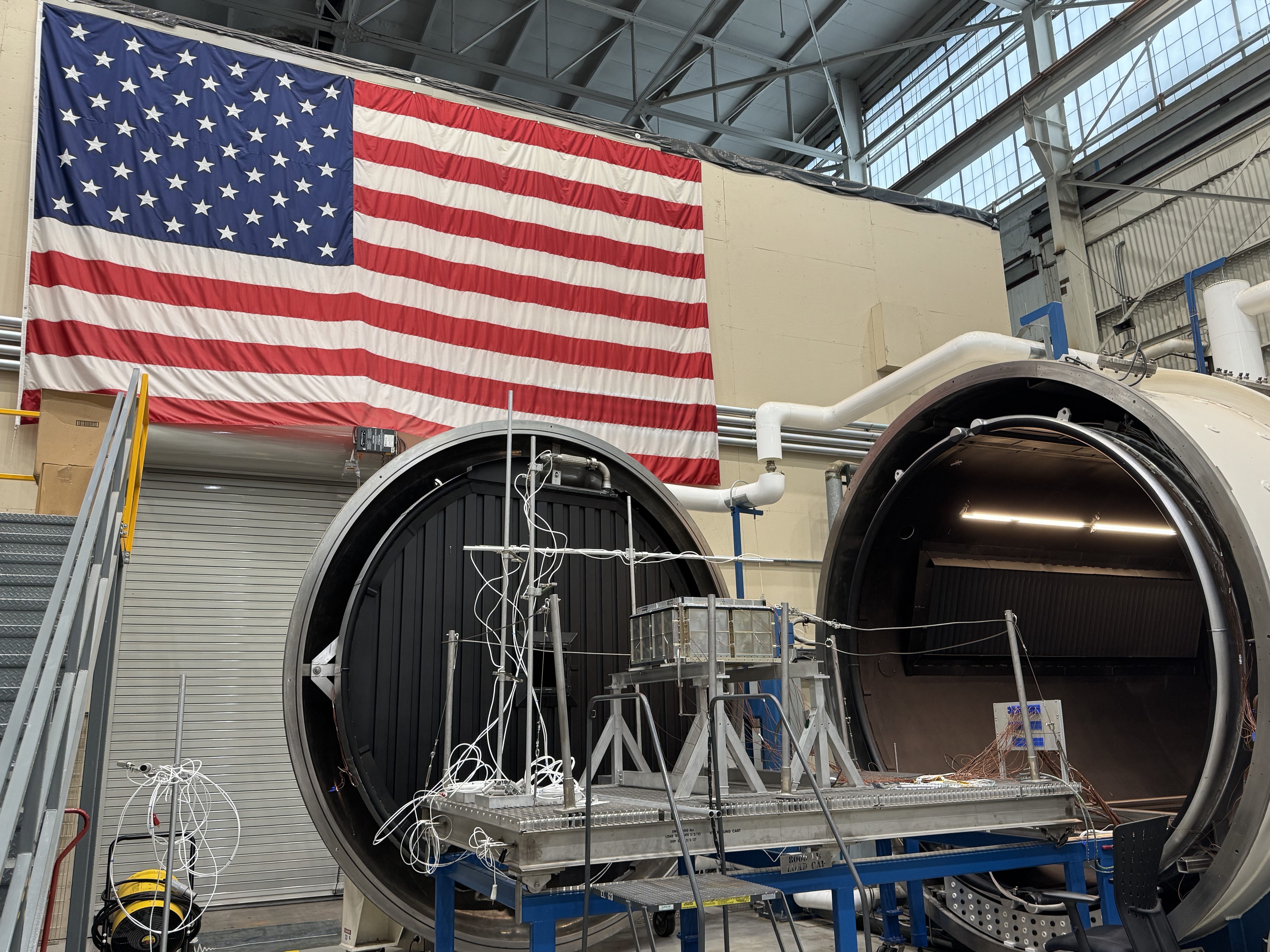
The Naval Research Laboratory transferred the instrument to NASA in early March 2025 and it arrived at Marshall on 4 March 2025 for environmental testing and final integration. Thermal testing ran in a vacuum chamber non-stop, 24 hours a day for 18 days, with radioactive material placed in the chamber so the instrument could detect gamma-ray signals during the tests. Engineers completed a 24-hour bake-out, and a vibration test bolted the instrument to a shaker table to simulate launch, using Marshall's Sunspot Thermal Vacuum Testing Facility and its Stray Light Facility.
The instrument shipped to the Space Flight Laboratory at the University of Toronto in August 2025, and Marshall staff travelled there in early September 2025 to help integrate it with the spacecraft bus.
"NASA's StarBurst mission is ready for its next stage of assembly and is one step closer to flight."
That was Kocevski, quoted by NASA on 9 January 2026.
What NASA has not said
Further calibration, vibration and thermal vacuum testing was scheduled for the following spring, and nothing published confirms it was completed, so the last public hardware milestone is still the Toronto integration in September 2025. The Bandwagon flight is not named: no mission number, no orbit inclination, no co-passengers and no month inside the window. Mission duration language is inconsistent, with NASA giving a nominal one-year mission in one place and one to three years on the mission page summary line. SpaceX has published nothing on the award, so the story carries NASA's words only.
More from Tech

PlayStation Cancelled Kojima's Next Game in June and Xbox Has Picked It Up
Physint moves to Microsoft after three decades of work between Hideo Kojima and Sony, and the new deal extends into film and television.

Device listings will have to show an equipment authorisation number under a new Commission order
A Federal Communications Commission order taking effect in October bars equipment authorisation for devices built with smart components from listed…

Three days to patch, and to prove nobody got in first
Twenty-six of the thirty-four vulnerabilities the United States cyber agency added to its known exploited catalogue in September carry a three-day…