Cancer Breakthroughs Used to Arrive Annually. Two Experts Say They Are Now Roughly Monthly
The acceleration is real, and both speakers argued the harder problem has shifted to whether people can actually get the drugs.
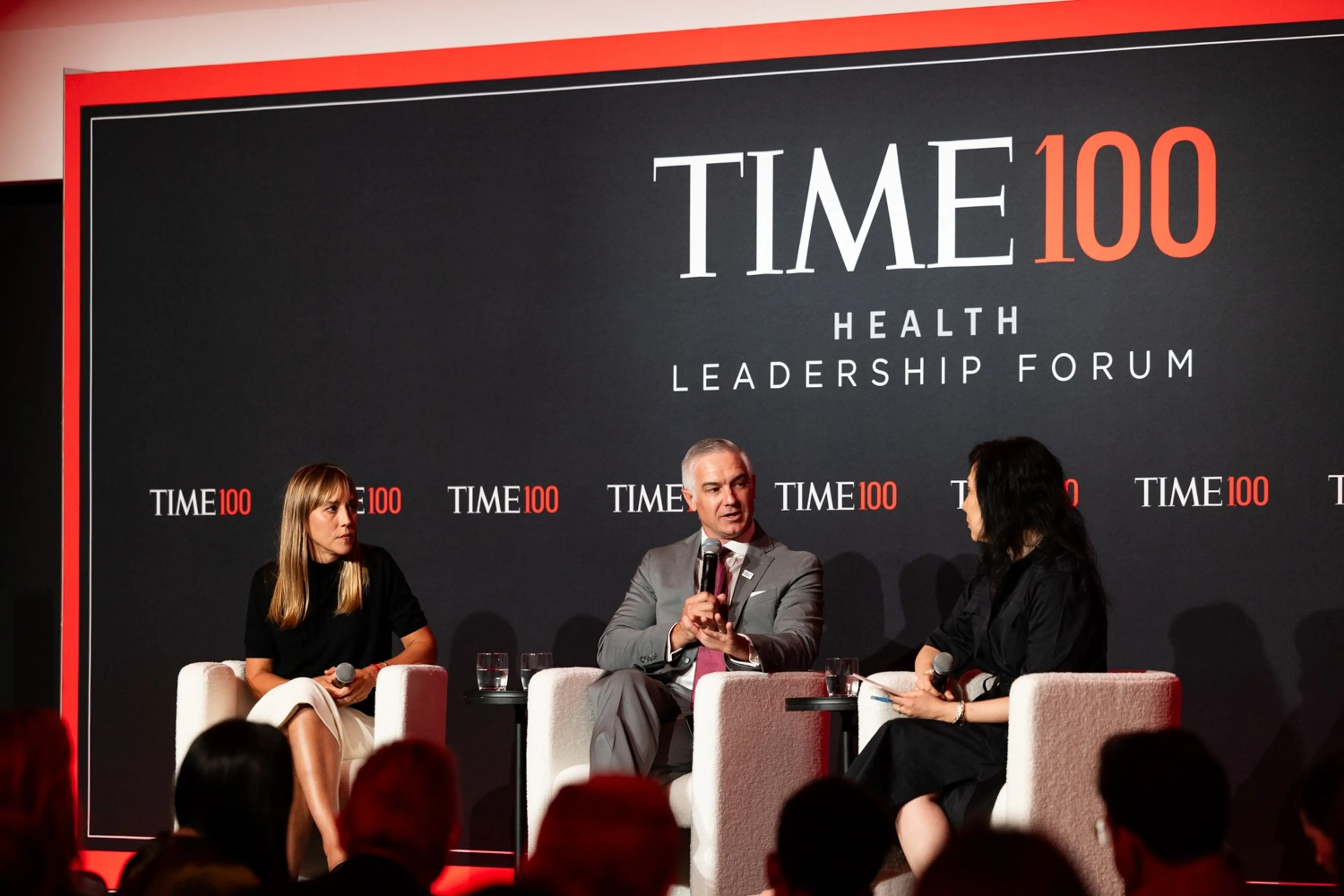
Leading cancer researchers used the TIME100 Health Leadership Forum in New York on Thursday to take stock of where the field has reached, and the tone was notably more confident than it would have been a decade ago.
Shane Jacobson, chief executive of the American Cancer Society and of its Cancer Action Network, put the scale of the problem first. Cancer, he said, is omnipresent. One in three men and women in the United States will receive a diagnosis at some point in their lives.
"It has been, historically, such a devastating disease," he said. "We knew so little about it that it has garnered resources, and it takes resources to tackle most of the problems we face in healthcare."
The pace has changed
That investment, from philanthropy and from federal funding, is what Jacobson credits for the current run of results.
He is careful about where those results come from. Developments such as the encouraging mRNA cancer vaccine data announced by Moderna and Merck last month stem, he said, from decades of progress, decades of new knowledge, and decades of failure that was learned from.
What has changed is the interval between them.
"It used to be maybe on an annual basis we would celebrate something significant, but the innovation is moving so rapidly that these celebrations, these big moments, are now almost on a monthly basis," he said. "And we should expect that speed to continue."
He immediately attached the qualifier that ran through the rest of the discussion: advances matter only alongside making sure everyone can actually access the drugs.
The immune system is really the most powerful drug we have
Why immunotherapy is the through-line
Dr Andrea Cercek, a gastrointestinal medical oncologist at Memorial Sloan Kettering, described what vaccines and immunotherapy have in common, and why both point the same way.
"The hope, between vaccines and immunotherapy as well, is that they harness the immune system, which is really the most powerful drug we have," she said. "It can fight anything as long as it's equipped to do so and it recognises something is foreign, and so it's really that combination that needs to happen for therapy to work."
Cercek is not describing this from a distance. In 2024 she and colleagues published findings from a study of patients with a specific type of rectal cancer, in which, after six months on an immunotherapy drug, none of the patients had detectable tumours. None of them required chemotherapy.
That is an extraordinary result, and the significant part is what it spared people rather than what it achieved. Chemotherapy and surgery for rectal cancer carry consequences that last for the rest of a patient's life.
She has since widened the research, and said during the panel that they are very close to seeing the same approach work for other cancers, sparing those patients the more invasive treatments too.
Will it be cured
Asked directly by the moderator whether cancer will be cured, and what a cure would look like, both answered without hedging.
"Absolutely we will," Cercek said. "Probably it will be with early detection and prevention. I think that is going to be, ultimately, what cures cancer."
That is a more interesting answer than it first appears. It locates the cure not in a drug that eliminates an advanced tumour, but in catching the disease before it becomes one.
Jacobson agreed, with one amendment that may be the most useful sentence of the session.
"Yes," he said. "And I think it's cures, plural. It's not one cure, and we're seeing that now."
More from Leadership

Only One in Five Women Knows She Is More Likely to Develop Alzheimer's Than a Man
Women account for roughly two thirds of diagnoses, and Maria Shriver wants the conversation about brain health to start decades before anybody…
The Chief Executive of a 350,000-Person Company Wants Digital Labour Taxed Like Human Labour
Ravi Kumar S runs Cognizant and argues that if a technology is deployed to eliminate work rather than amplify it, it should carry the same overhead a…

Fandom's New Chief Executive Has 300 Million Monthly Visitors Who Do Not Know Where They Are
Jay Sullivan took over a platform most of its own audience cannot name, and his fix is to build a simpler entrance without touching what is behind it.