In Key West There Is Nowhere for an Immigrant Community to Absorb the Losses
On an island whose economy runs on the people now being detained, a volunteer network has spent a year delivering groceries to families too frightened to shop for themselves.
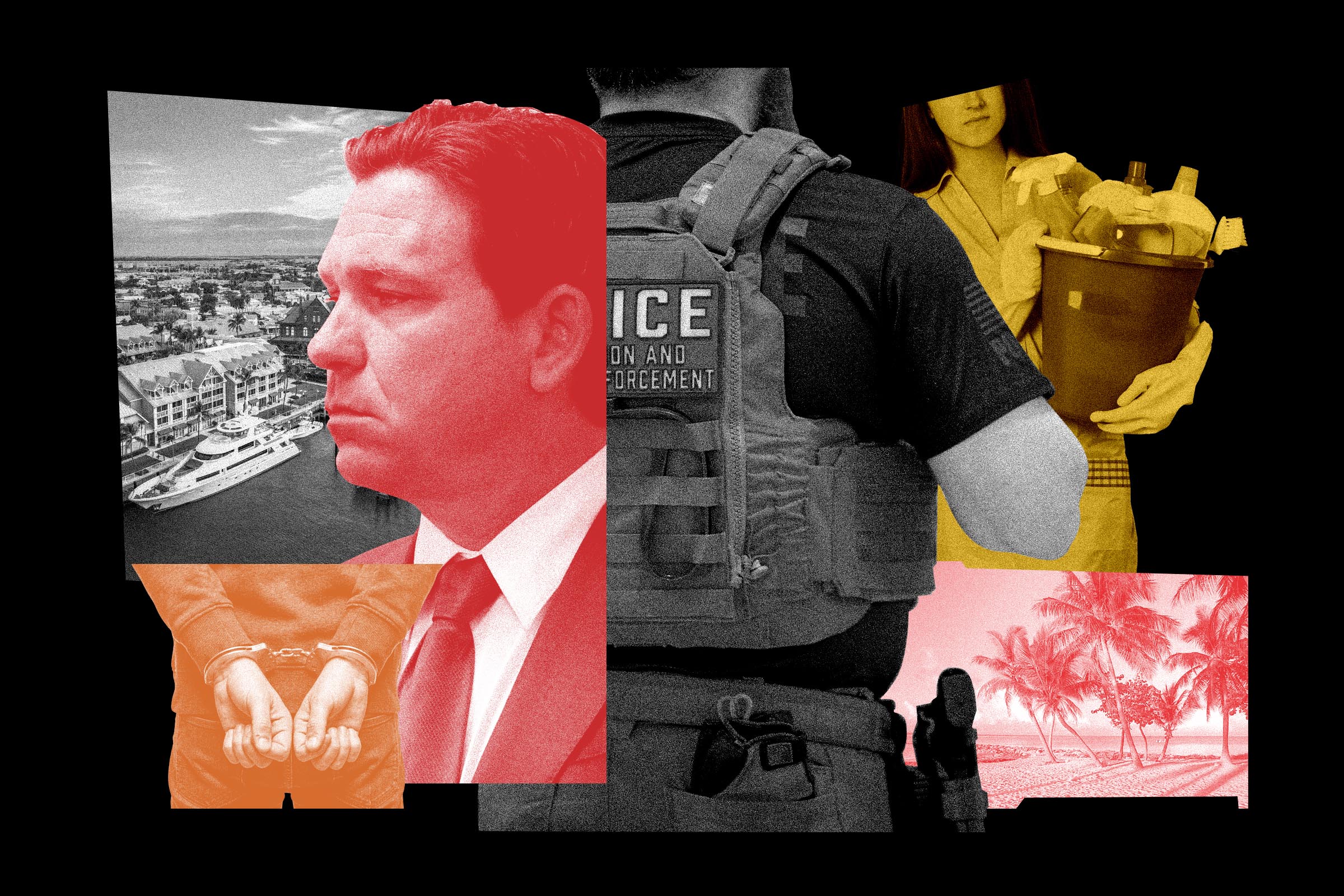
The woman opens her front door only partway. Before she steps out she looks left, then right, scanning the narrow street the way you might check the sky for rain. When she is satisfied, she crosses to the car and takes the bags: rice, chicken, bell peppers, maseca. A child appears in the doorway and is firmly steered back inside. The whole exchange takes three minutes. Then the door closes.
This is a delivery run in Key West, Florida, and the care taken over it is the point. The groceries are ordinary. The circumstances under which they have to be handed over are not.
Key West sells itself as a place of effortless leisure. Resorts, sunset cruises, dinner by the water. What holds that fantasy up, mostly out of sight, is a workforce drawn largely from Latin America and Haiti: the line cooks, the housekeepers, the delivery drivers, the construction crews who maintain the waterfront houses that appear in the brochures.
An island cannot absorb it
Immigration enforcement across the United States has widened in ways that are diffuse and hard to picture as a whole. Workplace audits. Courthouse arrests. Early-morning raids that move through a city and vanish back into its scale. In a large place the effect is uneven, and neighbourhoods replenish themselves.
The Keys have no such buffer. There is one road to the mainland, and license-plate scans on it have become routine.
Since the spring of 2025, Customs and Border Protection agents have intensified enforcement across the islands, detaining people on bike paths, in Ubers and at school drop-offs. For most of those taken, the offence is not having been born here.
On a typical day about two people are removed from the Keys, according to figures kept by the Key West Immigrant Support Network. Bad days reach six to nine. Most of those detained are documented, holding work permits, pending asylum cases, social security numbers, visas.
They have done everything the way our government says you should, and they are still being detained
The network
Lucy Hawk, 36, co-founded the support network in June 2025, and puts the central fact of it plainly. The people being taken, she says, have done everything the government says a person should do to enter the country. They have done that, and they are still being detained.
In recent weeks, according to Hawk, detentions have risen sharply as enforcement has turned towards Haitian immigrants who have just lost Temporary Protected Status. The legal ground moved underneath them, and the consequence arrived immediately.
What the network does is unglamorous and mostly logistical. Groceries to households where no adult will risk a supermarket. Rides that avoid the single road. Information about who was taken, from where, and where they have been moved. The volunteers are not running a legal defence operation. They are keeping families fed while the legal system decides what happens to them.
The secrecy in that three-minute exchange is not caution for its own sake. A household that loses its earner on a Tuesday has no income by Friday, and no wider community able to make up the difference, because the wider community is in exactly the same position.
A state programme, not a local surge
None of this is incidental or improvised. In late April 2025, Immigration and Customs Enforcement launched Operation Tidal Wave across Florida, a six-day joint enforcement effort that produced 1,120 arrests. It was the largest single-state immigration sweep conducted in a one-week period in the agency's history.
Governor Ron DeSantis described the state as the tip of the spear of federal immigration enforcement. The operation did not conclude at the end of those six days. It became a standing framework, and by January 2026 it had logged more than 10,000 arrests.
Set that against the economics of the place and the tension is obvious. The hospitality industry that the Keys depend on is staffed substantially by the population being removed from it. Nobody has explained who is expected to make the beds and cook the dinners once the policy has finished working, and the question is not being asked loudly by the businesses that would have to answer it.
What the island shows
The value of Key West as a case study is its size. Enforcement at this intensity in Miami or Chicago disperses into a population large enough to hide it. Here, across a handful of islands connected by one road, the arithmetic is legible. Two people a day, from a workforce this small, is not a statistic. It is a visible subtraction, felt in specific restaurants and on specific building sites within the week.
It is also why the groceries are handed over the way they are: quickly, quietly, with a look up the street first. Not because anyone believes a bag of rice is contraband, but because on an island there is nowhere for a family to go once somebody has noticed them.
More from News

A Netflix Caption, an Anniversary, and a Row That Was Always Going to Happen
A six-word promotional post about a television drama landed on the first anniversary of Charlie Kirk's killing, and the streamer now says any…

Raz-B and Mona Li Thornton Have Announced the Death of Their Three-Month-Old Son
The couple confirmed the loss of Astro Monte Thornton through a spokesperson on Thursday, and have asked for privacy.

Fifteen Celebrities Are Going Into the Malaysian Jungle, and Two of Them Already Do Not Get Along
Special Forces returns on September 24 with no votes and no eliminations, which leaves only the terrain and the other recruits.