Thirty-eight companies filed a form with the SEC, then sold the filing as proof the SEC had approved them
The Securities and Exchange Commission says the paperwork it never reviews became the evidence of legitimacy, and it has now spelled out in court exactly what a filing does and does not certify.
The play behind 38 lawsuits the Securities and Exchange Commission filed last month works on people who think they are being careful. Fill in a form. Send it to a federal regulator. Wait for its website to publish the form. Then point at the page and call it a licence.
On 27 August 2026 the Commission filed 38 separate civil complaints in the U.S. District Court for the District of Colorado, one per named entity, with case numbers running from 1:26-cv-03951 to 1:26-cv-03995. Every complaint charges the same two violations of the Investment Advisers Act of 1940: Section 207, untrue statements of material fact in a report filed with the Commission, and Section 204(a), failure to produce books and records.
The form is Form ADV and the status claimed on it is exempt reporting adviser — under the complaints, a firm advising only private funds with less than $150 million under management in the United States. It is not registered. It is not approved. It files a check-box page through the Investment Adviser Registration Depository, which FINRA runs for the Commission, and the filing then appears on a public government website. Paragraph 3 of the CryptoOrbit complaint describes what follows.
"As a so-called exempt reporting adviser ('ERA'), Defendant filed its Form ADV in an investment adviser registry with the apparent expectation that, upon submission, the form would promptly become available to the public on a Commission maintained website. This is precisely what happened, as the Commission does not review and approve such ERA filings before they are published."
What the filing does not certify
Paragraph 37 of the Pinnacle Crypto Exchange complaint states the negative in full.
"The Commission does not issue any type of certificates to ERAs (or registered advisers for that matter). In addition, an ERA is not a registered investment adviser and therefore is not a 'RIA.' In any event, the Commission does not grant any 'permissions' with respect to ERAs, nor does it review the abilities or qualifications of ERAs. Rather, Forms ADV filed by ERAs become publicly available on the Commission's IAPD website upon acceptance of the submission by IARD."
Its investor education staff said the same that day, and drew the instruction from it: "Do not trust any individual or firm that claims to be an ERA and directs you to a filing or website as evidence of SEC registration." A 2014 alert had already put it in one line: "The fact that an individual or firm has made a filing with the SEC does not mean that the individual or firm is registered with the SEC."
The fingerprints across 38 filings
The numbers barely move across the group. All 38 filings claimed one adviser advising one private fund, usually named after the adviser. The fund's reported gross asset value was either $78,960,522 or $48,960,522 — only the first digit differs. The investor count was either 89 or 33. The minimum commitment was either $50,000 or $5,000. Ownership percentages were identical throughout: 10% adviser or related persons, 90% foreign investors, 50% funds of funds.
Two auditor names cover all 38. "Indicator Global" appears in 36 complaints and "Inno&Prosperity" in two, both given a New York office, and the Commission says neither appears in any public registry of federal or state accountancy firms. Each filing claimed U.S. GAAP statements with an unqualified audit opinion. None disclosed a website, which Form ADV requires of advisers that have one, while at least 23 were marketed on them.
All 38 claimed a Colorado principal office, 31 in Denver, and one suite at 9888 W Belleview Ave Ste 2142 is the filed office of four separate defendants. In 25 of the complaints the defendant is a pre-existing company whose name, address or both were changed at the Colorado Secretary of State shortly before the filing. Paragraph 8 says active standing in Colorado, obtained through the Secretary of State, is used in conjunction with Commission filings "to falsely portray businesses as legitimate advisory firms to investors."
It came apart on contact. Certified letters mailed in April 2026 came back undeliverable, marked that no such entity was at the address; the phone numbers were disconnected or belonged to unrelated businesses; June letters to the FINRA contact addresses went unanswered.
The certificate the regulator printed
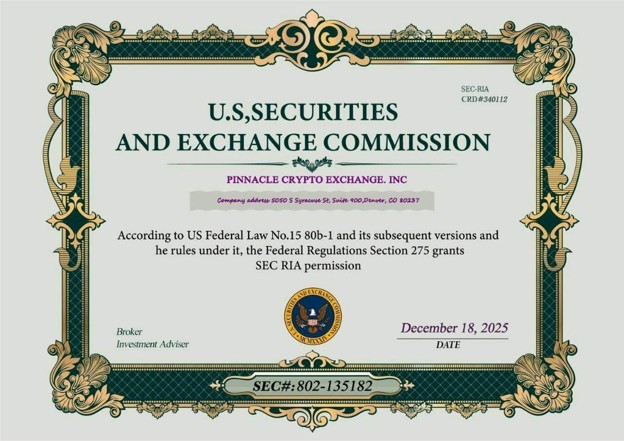
Four complaints allege the entity's website displayed a fabricated SEC certificate, each dated the same day as its Form ADV. The Commission published one. It carries the registration depository and file numbers assigned the moment an entity files, plus the words "SEC RIA permission". The header punctuates the agency's own name wrong.
How to check an adviser yourself
Each step below is the regulator's own instruction, taken from staff bulletins the Commission notes are not rules, regulations or statements of the Commission itself.
- Start at "Check Out Your Investment Professional" on Investor.gov, the tool that runs on the public adviser disclosure database, per the Commission's 2020 bulletin.
- Choose individual or firm and type the name. A firm can be an adviser, a brokerage or both, and the bulletin says to search both ways if you are unsure.
- Click "Get Details" for a firm or "Get Full Report" for a person, and read both where there are two buttons. The same bulletin says the summary page carries a Registration status: whether the firm is registered with the Commission or with one or more states, and from when.
- To confirm SEC registration, the 2014 alert points to the "SEC Registration Status" link on the firm's page, and for a person to the "Qualifications" section of the representative report.
- For brokers, the 2014 alert points to FINRA BrokerCheck or its hotline, (800) 289-9999.
- Call the state regulator too, which the 2014 alert urges, through the North American Securities Administrators Association, on (202) 737-0900.
- Check the Commission's Public Alert: Unregistered Soliciting Entities list, named in the 2014 alert, and its Action Lookup for Individuals database.
FINRA pulled all 38 Forms ADV from the public database on or about 24 August 2026 at the Commission's direction, three days before the complaints were filed. No dollar figure for investor losses appears anywhere in them: the charge is false filings and failure to produce records, not fraud on investors, and the Commission does not say how much, if any, was taken. No human being is named in any of the 38 complaints, and no defendant has answered, so there is no defence to report. In two earlier cases from the same wave, courts entered default judgments barring the company, its owners and its executive officers from filing a Form ADV as an exempt reporting adviser, with a civil penalty of $1,182,254 each.
More from Business

Nvidia Is Buying Hugging Face for 12.93 Billion Dollars and Promising Not to Change It
The company that sells the hardware is acquiring the platform where developers choose what to run, and the whole deal rests on a pledge of neutrality.
The SEC says Tricolor pledged the same car loans twice, and an analyst caught what the audits missed
Court filings in the collapse of Tricolor Holdings describe a funding machine in which the same subprime auto loans were pledged to more than one…
FleetCor agrees to pay $100 million over fuel-card fees its customers could not find on an invoice
The order is not final and the Federal Trade Commission has not said how the money reaches the tens of thousands of small businesses it says were…